
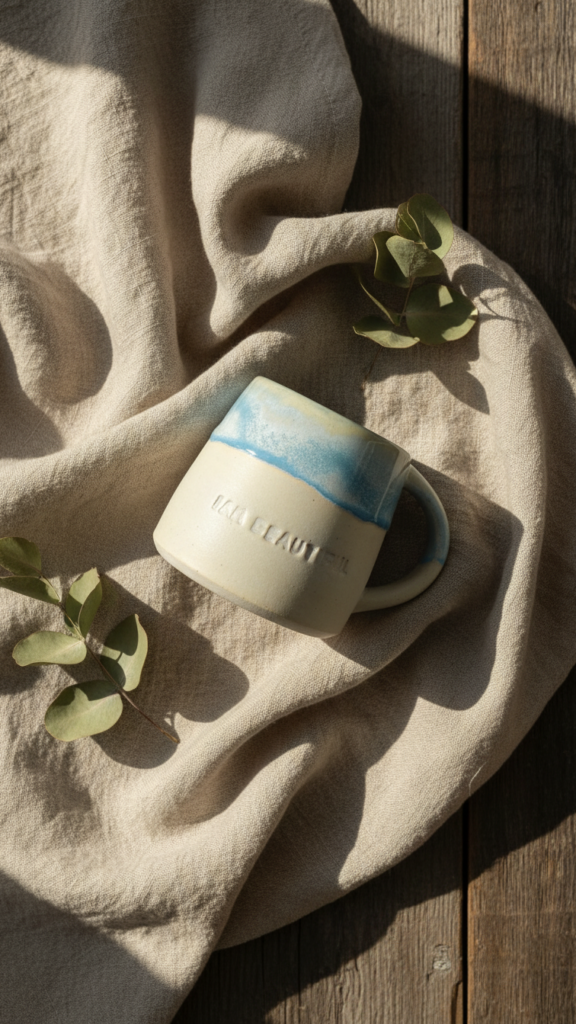
What Happens to Clay Before It Becomes a Cup
On the long, quiet journey from earth to table — and everything that can go wrong, and right, in between.
Pick up a handmade ceramic mug. Feel the weight of it — slightly heavier than you expect, slightly imperfect at the rim, warm from whatever is inside. You probably do this every morning without thinking much about it.
But that mug has been through quite a lot to get to you.
It begins with clay
Clay arrives at my studio in heavy blocks, smelling faintly of soil after rain. Before anything else, I wedge it by hand — pushing, folding, pressing — to drive out every air bubble. One bubble left inside and the piece explodes in the kiln. So I wedge until it’s perfect. Every time, for every piece.
The wheel
Throwing is the part people imagine — spinning clay, wet hands, a shape rising. What they don’t imagine is how much goes wrong before it goes right. Centering alone takes years to do reliably. You have maybe ten minutes of workable time before the clay dries and stops listening.
When it works, there is nothing quite like it. When it doesn’t, you reclaim the clay and begin again. No piece is precious until it survives the kiln.
| No piece is precious until it survives the kiln. |
Drying, trimming, the first fire
Fresh pieces dry slowly over days — too fast and they crack. Once leather-hard, I trim the base, attach handles, smooth the edges. Then the bisque fire: 1,000 degrees, hours to heat, hours to cool. After this, the clay is permanent. There is no going back.
Glaze — and the part that matters most to me
Glaze looks nothing like its finished colour before firing. The warm terracotta and sage you see in Moksha pieces are grey and pale in the bucket. The kiln reveals everything.
But before a glazed piece goes into the kiln, I pause. I hold it. I close my eyes and speak an intention into it — quietly, privately. You are enough. You are loved. May this hold something good.
This is what I call Affirmative Alchemy. The belief that the words we speak into objects become part of what those objects carry. I cannot prove it scientifically. But I have felt it. And I think, sometimes, so have the people who use these pieces.
| The words we speak into objects become part of what those objects carry. |
The second fire — and the wait
The glaze fire runs to 1,280 degrees. At this temperature, glaze melts and fuses to the clay permanently. The piece becomes dense, non-porous, built to last a lifetime.
Then the hardest part: waiting twelve to twenty-four hours for the kiln to cool. Every time I open one, I hold my breath a little. The colours are transformed. Occasionally something has cracked and is gone. Both are part of the process. Both have taught me something.
To your hands
After the kiln, each piece is inspected and packed carefully. The ones that go out have survived fire, time, and a hundred small decisions made by one pair of hands.
That is what you are holding every morning. Not just a mug — but a quiet record of someone paying attention.
| Every Moksha piece has been through this entire journey. Browse the collection at mokshapotterystudio.com → |
— Nidhi